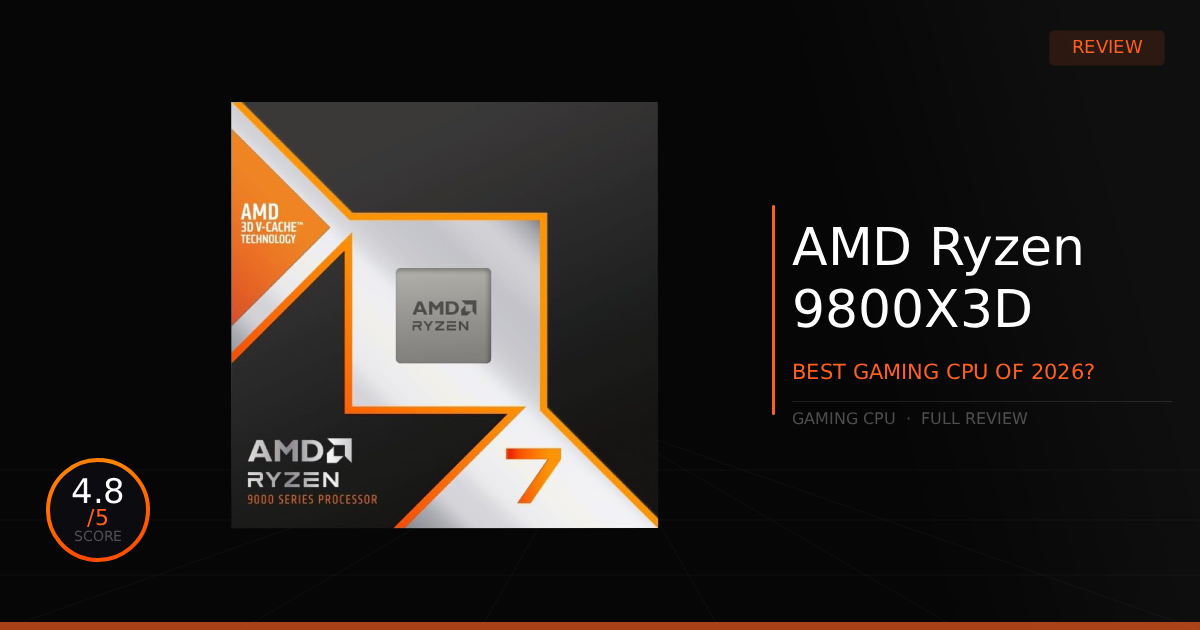
Possibly AMDs Greatest CPU Innovation
It's no secret, the Ryzen 7 9800X3D has cemented itself as the best gaming CPU of 2025. After dominating the market throughout 2025, it remains the 'king of gaming' for enthusiasts and casual builders. A title it’s likely not to surrender until the next big generation of CPU’s comes around.
GTT Quick Score: 4.8/5
Quick Verdict:
The Ryzen 7 9800X3D easily defends its crown as the undisputed king of gaming CPUs, delivering unmatched high refresh rate smoothness and rock-solid 1% lows thanks to its game-changing 3D V-Cache. Unless you are on a strict budget or require a massive core count for heavy professional workloads, this is the absolute ultimate, no-compromise desktop upgrade.
➔ Check Price At Amazon
➔ Check Price At Newegg
Our Summary:
The 9800X3D is top class for any gamer looking to achieve peak performance at very high refresh rates such as (240hz+) for competitive titles. Not to mention its 3D-VCache technology making all gaming CPU bound scenarios perform super well with great 1% lows. Lastly daily tasks and even some work will handle perfectly fine.
Why this matters for you:
You are able to run any software like discord or listen to music while playing games at extremely high frame rates without the frustration of dealing with stutters mid game. In return, results in having a visually smoother experience on high refresh rates that does not have screen tearing which always causes annoying distractions. We've all been there, seeking low latency and perfect in game smoothness.
Ryzen 7 9800X3D: Why the Specs Matter
Technical Specification | Ryzen 7 9800X3D Details | Why It Matters for Gaming |
|---|---|---|
Core Configuration | 8 Cores / 16 Threads | Represents the absolute sweet spot for modern game engines. It allocates processing loads efficiently, ensuring that background tasks like Discord or streaming apps never steal execution cycles from your main game thread. |
Sustained Clock Speeds | 4.7 GHz Base / 5.2 GHz Boost | Re-engineers the physical chip layout by placing the cache under the compute die. This massive structural flip allows the processor to dissipate heat faster, sustaining a higher 5.2 GHz top-end boost clock than previous X3D models. |
3D V-Cache Layer | 96MB L3 Cache | Acts as a super-fast local memory reservoir right on the CPU. By holding massive game engine instruction maps locally, it drastically reduces trips to your system RAM, vaporizing frame drops and micro-stutters in asset-heavy open-world titles. |
Thermal Power Envelope | 120W Thermal Design Power (TDP) | Delivers exceptionally high thermal efficiency. Because the Zen 5 architecture runs inherently cooler under gaming workloads, it is incredibly easy to keep chilled using standard dual-tower air coolers or 240mm AIO liquid setups. |
Platform Longevity | Native Socket AM5 Infrastructure | Ensures a robust, future-proof upgrade trajectory. AMD has committed to supporting the AM5 ecosystem well through 2027 and beyond, allowing you to swap in next-generation processors down the line without buying a new motherboard. |
Tuning & Overclocking | Precision Boost Overdrive (PBO) & Fully Unlocked Multipliers | Stands as the first 3D V-Cache processor to be completely unlocked for traditional overclocking. It allows hardware enthusiasts to easily alter voltage curves and surpass factory speed boundaries for unprecedented, tier-breaking frame rates. |
Pros & Cons for the Ryzen 7 9800X3D
Pros
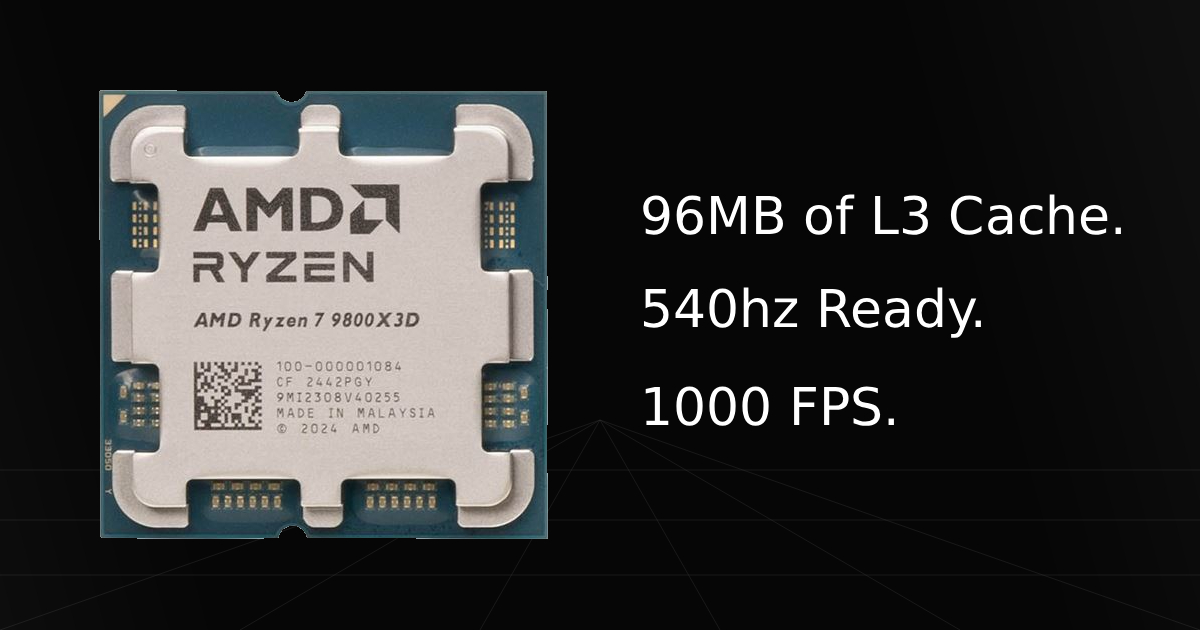
96MB of L3 3D V-Cache: The main selling point, achieving much higher FPS with way fewer micro-stutters.
Fantastic 1% Lows: Delivers an incredibly smooth gaming experience paired with high overall framerates.
Generational Leap: Offers a 10-20% performance uplift over the previous generation.
Daily Use: The perfect chip for everyday gaming and effortlessly handling simple tasks.
Cons
High Cost: Expensive for gamers on a strict budget, with prices still sitting around $460+ USD.
Productivity Limitations: Features a lower core and thread count, making it less ideal for heavy professional workloads when compared to a monster chip like the 9950X3D.
Platform Jump: Because the AM5 platform is strictly DDR5, you are forced to upgrade your RAM if you are coming from an older DDR4 system.
Real World Performance with the Ryzen 7 9800X3D
We’ve gathered data from over 20+ game benchmarks to show you exactly what to expect at 1080p low settings for competitive gaming and ultra settings for casual gaming (paired with an RTX 5090 GPU or similar tier GPU).
Game Title | 9800X3D (Avg FPS) | 9800X3D (1% Lows) | vs. 14900K (Avg FPS) | vs. 14900K (1% Lows) | GTT Performance Lead |
|---|---|---|---|---|---|
Fortnite (1080p Low/Perf) | 764 | 528 | 608 | 392 | +25.6% |
CS2 (1080p Low) | 932 | 702 | 774 | 538 | +20.4% |
Valorant (1080p Low) | 1,108 | 844 | 922 | 674 | +20.1% |
Cyberpunk 2077 (1080p Ultra) | 208 | 158 | 186 | 144 | +11.8% |
Red Dead Redemption 2 (1080p Ultra) | 184 | 142 | 174 | 134 | +5.7% |
Forza Horizon 5 (1080p Ultra) | 306 | 252 | 288 | 224 | +6.2% |
Daily Use & Performance
This chip thrives for the daily user; you get the ultimate gaming experience, great basic work performance, and it handles general multitasking better than most "8 Core / 16 Thread" competitors.
As if we haven’t mentioned this already: this chip really games. As for why it handles gaming so well, we can thank the single CCD architecture (which reduces latency), the 3D V-Cache, high stable boost clocks, and a 15% uplift in Instructions Per Cycle (IPC). The only caveat to gaming is the occasional "AMDip." Usually, this is fixed with chipset drivers and adjusting a few Windows settings. While we have experienced it, it usually stems from bad OS updates or software bugs, a rare occurrence and a very fixable one, much like any new PC build might experience.
In 2026, the 9800X3D sits in a unique mid-to-high-tier spot. To no surprise, like most modern CPUs, it handles moderate compute-intensive tasks with ease. Video editing, encoding, streaming, or Blender. It can really do it all, especially when paired with a powerful GPU. It only starts to struggle when you head into extremely intensive workloads where professionals need those extra cores and threads. To be fair, those extra cores make a huge difference in cutting down export times for 8K video, rendering complex 3D projects, or running multiple virtual machines.
For general daily use, it’s a breeze. There is a massive benefit to 3D V-Cache technology that people often overlook. Simply put: the 104MB of total cache allows the CPU to store more active data directly on the die, lowering the number of "trips" the processor has to take to your RAM. This impacts latency dramatically, making multitasking more efficient and improving your workflow. It generally makes your computer feel snappier, even if you're just browsing the web while a game is running in the background.
Who Shouldn't Get The Ryzen 7 9800X3D
While the 9800X3D is an amazing CPU, realistically, it isn't the solution for everyone. You might want to look elsewhere or save your money for the next generation if you fall into these categories:
Budget Builder: Perhaps you’re looking for an entry-level system or you have valid concerns about the current outrageous DDR5 prices. If you don't care about squeezing out every last frame and just want a machine that games well, you don't need this chip. If you want the AM5 platform for future upgrades, go with a cheaper chip like the Ryzen 5 7500F. If you need more speed on a budget, consider sticking with Intel and a DDR4 motherboard to save cash for a better graphics card.
Professional "Get Work Done" User: If you are worried about hitting deadlines on heavy workloads, you’ll likely need to fork out more for a high-end "Dual CCD" chip. You should look toward the Ryzen 9 9950X3D, the standard 9950X, or even the older 7950X. Intel remains a strong contender here as well, with the 14900K or the newer Core Ultra series being better suited to turn hours of rendering into minutes.
4K Resolution Gamer: If you exclusively game at 4K resolution, you won't always see a massive performance jump. At 4K, the GPU usually becomes the bottleneck long before the CPU does. The only time this isn't true is in very CPU-intensive titles or Esports games played on low settings. That’s the only scenario where the extra L3 cache can really carry you to a victory.
Existing 7800X3D Owners: Being 100% honest: if you already have the previous generation, you don't need this upgrade, even if it is a measurable jump. Both are still top-tier chips. Unless you play specific games that benefit extremely well from the IPC uplift, or you’re chasing a constant 360hz - 540hz competitive experience, keep your current chip and save your cash for a future GPU upgrade or a new monitor.
Game Tested Tech Score: 4.8/5
The Verdict
It’s no question, it is the king of CPU’s, achieving the best gaming experience possible, easily reaching stable high framerates for super high refresh rates such as 240hz, 360hz, and even 540hz. This is the no compromise CPU for any gamer and continues to be a great productivity chip too.
Our Personal Advice
The 9800X3D is amazing at all workloads for most people. If you are a gamer and want the best performing chip, grab the 9800X3D. However, there are other nuances to consider, such as price and heavy production workloads.
If you are concerned about multi-threaded performance, you might actually want a chip closer to a 14900K or a 9950X3D. Conversely, if you are a gamer on a tight budget, take a look at the 7800X3D for better price to performance. While the 9800X3D is one of the greatest chips ever made, it isn’t exactly the best at everything and still costs a pretty penny not to mention the rise of the DDR5 RAM shortage in early 2026.